Collagen Peptides vs. General Protein Hydrolysates: Manufacturing Differences That Matter
For a protein hydrolysate manufacturer, collagen peptides are not just another hydrolysate category. They behave differently in pre-treatment, hydrolysis, viscosity development, filtration, sensory outcome, and batch release control.
General protein hydrolysates can be produced from dairy, plant, meat, fish, egg, or mixed protein substrates. Collagen peptide production usually starts from collagen-rich raw materials such as hides, skins, bones, scales, or connective tissue. That difference in protein structure changes the manufacturing strategy from the first heating step through final clarification and drying.
Enzymeproduct supplies enzyme systems for controlled hydrolysis in industrial protein processing. As an enzyme supplier for protein hydrolysate production, we help manufacturers match enzyme selection to substrate, target peptide profile, processing window, and downstream performance.
The main difference starts with protein structure
Collagen is a structured, fibrous substrate
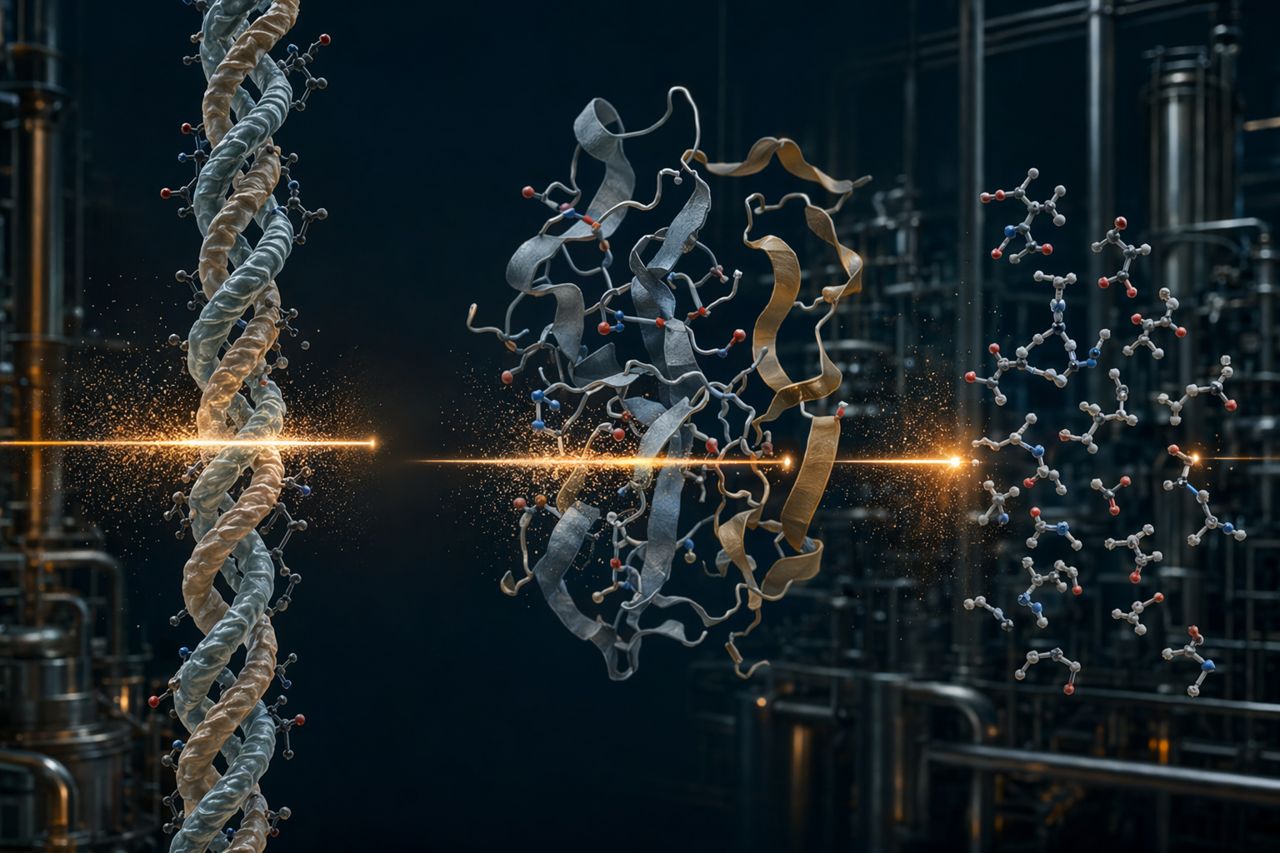
Collagen has a highly organized triple-helix structure and a connective tissue origin. Before enzymatic hydrolysis can be controlled well, the substrate often needs effective conditioning. This may include thermal gelatinization, hydration control, pH adjustment, and removal of interfering materials depending on raw material quality.
In production terms, collagen processing is often about converting a structured, fibrous input into a predictable gelatin or collagen slurry before enzymatic cutting begins.
General protein substrates are more diverse
General protein hydrolysates may come from soluble proteins, concentrates, isolates, meals, side streams, or mixed raw materials. Their structure, solubility, fat content, ash content, anti-nutritional factors, and heat history can vary widely.
A dairy protein hydrolysate line does not behave like a soy, pea, fish, poultry, or yeast hydrolysate line. Each substrate brings different risks for viscosity, foam, insoluble load, off-notes, and filtration burden.
Hydrolysis control is not the same
Collagen peptide production typically targets a narrower functional profile
Collagen peptide customers often expect clean solubility, neutral sensory impact, controlled molecular size distribution, and consistent behavior in beverages, powders, tablets, and functional foods. The production objective is usually a defined peptide profile rather than broad protein breakdown.
That means the enzyme program must support:
- Predictable viscosity reduction
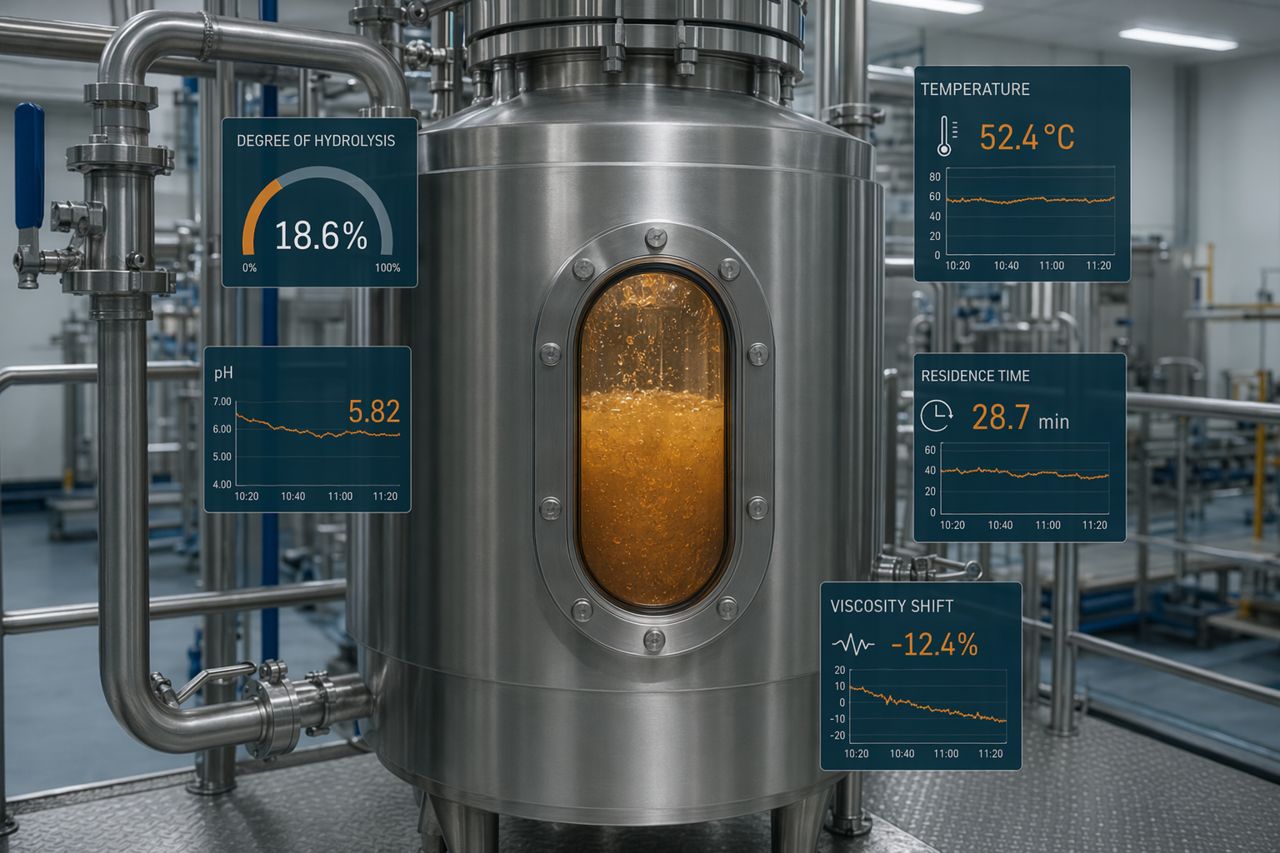
- Controlled degree of hydrolysis progression
- Repeatable peptide size distribution
- Low insoluble residue after hydrolysis
- Stable filtration and concentration behavior
- Clean taste profile where required
Collagen hydrolysis can move quickly once the substrate is properly conditioned. Over-processing may create unnecessary bitterness or shift the peptide profile outside the desired specification.
General protein hydrolysates may target function, nutrition, digestibility, or flavor
General protein hydrolysates have a wider set of commercial targets. Some manufacturers produce hydrolysates for digestibility. Others target emulsification, solubility, fermentation nutrition, animal nutrition, savory flavor systems, allergen management, or specialty nutrition applications.
Because the end-use range is broader, the hydrolysis endpoint may be defined by different process indicators:
- Solubility improvement
- Viscosity reduction
- Filtration rate
- Flavor release
- Nitrogen recovery
- Functional performance in the final application
- Consistency against customer specification
This wider target range usually requires more substrate-specific enzyme selection and process tuning.
Raw material variability affects collagen and general hydrolysates differently
Collagen variability is often linked to source, age, pre-treatment, and extraction history
Collagen-rich materials can vary in crosslinking, mineral load, fat content, prior thermal exposure, and extraction severity. These differences influence gelatinization, slurry behavior, hydrolysis speed, and final clarity.
For manufacturers, the key operational risk is not only raw material quality. It is how the raw material changes the usable processing window. A collagen batch that heats, hydrates, or liquefies differently can shift enzyme performance and downstream filtration.
General protein variability is often broader and more chemistry-dependent
Plant proteins may carry fiber, starch, polyphenols, anti-nutritional factors, or residual oil. Animal proteins may contain fat, connective tissue, minerals, or heat-damaged fractions. Dairy proteins are strongly affected by heat history and mineral balance. Marine proteins may create odor and oxidation challenges.
For these substrates, enzyme selection must account for both protein accessibility and the non-protein matrix around it.
Enzyme selection: precision matters more than maximum breakdown
A common mistake is treating hydrolysis as a push toward more breakdown. In commercial production, more is not always better.
The right enzyme system should create the target peptide profile inside the available plant constraints. That includes pH, temperature, residence time, viscosity, solids content, and downstream equipment limits.
For collagen peptides, enzyme programs often need to deliver controlled cutting with good solubility and low filtration burden. For general protein hydrolysates, the enzyme program may need to balance protein breakdown with bitterness control, functionality retention, or recovery yield.
Enzymeproduct supports manufacturers with enzyme selection focused on practical production outcomes:
- Consistent batch-to-batch hydrolysis behavior
- Controlled processing windows
- Better alignment between enzyme choice and substrate structure
- Reduced risk of over-hydrolysis
- Improved downstream separation behavior
- Technical support during scale-up and process adjustment
Downstream filtration behavior can define profitability
Hydrolysis performance is not finished when the reaction reaches its target. The next question is whether the hydrolysate separates, clarifies, concentrates, and dries efficiently.
Collagen peptide streams often require clean clarification and stable concentration
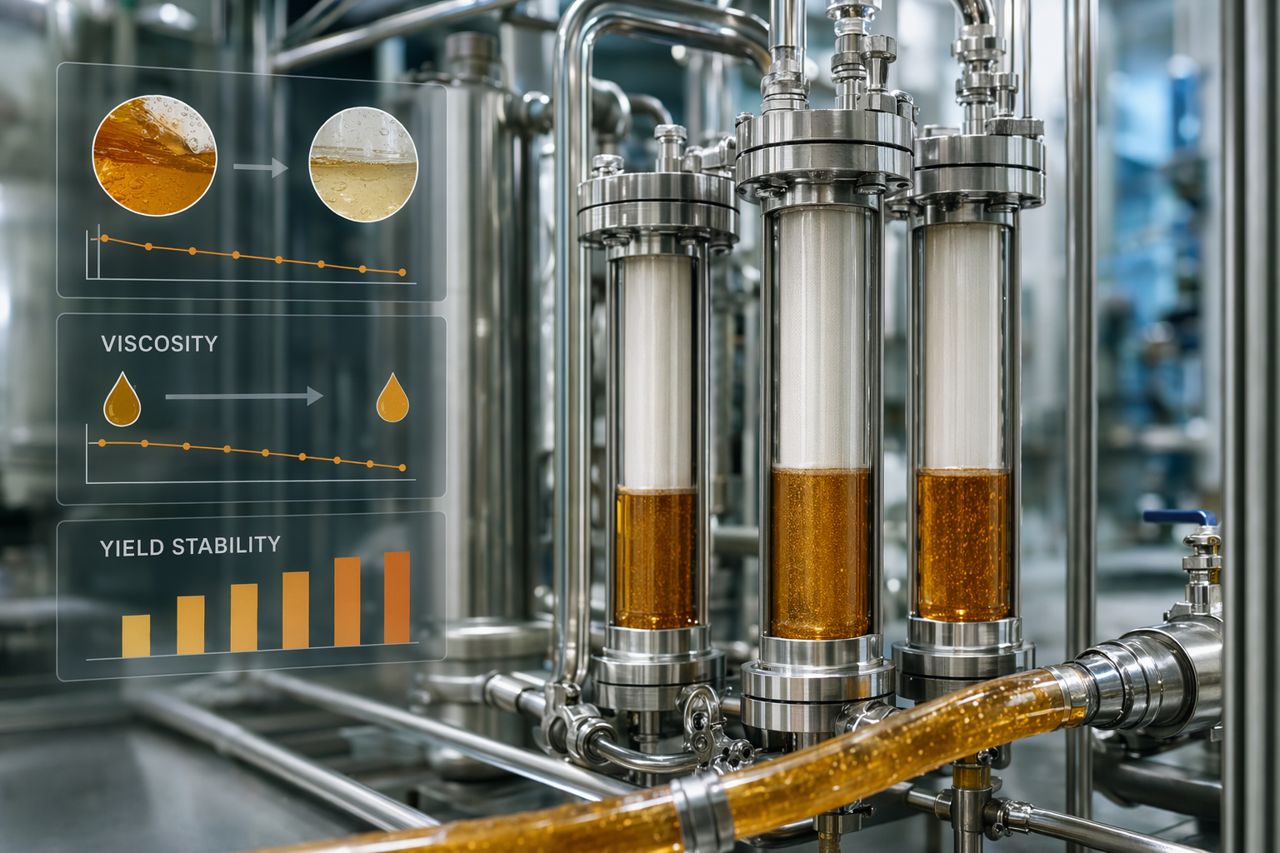
Collagen peptide lines usually aim for low turbidity, good solubility, and reliable performance in evaporators, membrane systems, polishing filters, and dryers. Poor hydrolysis control can leave insoluble residue or create variability in viscosity and filter loading.
The manufacturer may see the issue as slow filtration, unstable concentrate behavior, fouling, or inconsistent powder quality.
General protein hydrolysates may carry more insoluble and non-protein load
Plant, meat, fish, and mixed protein hydrolysates can generate heavier solids handling challenges. Fiber, fat, minerals, denatured proteins, and fine suspended particles may all affect separation.
In these cases, enzyme selection is only one part of control. But it is a critical part because peptide formation, viscosity shift, and solids release influence the behavior of the entire downstream train.
Sensory risk differs by product type
Collagen peptides are often positioned in consumer-facing nutrition formats where neutral taste, low odor, and easy solubility matter. Uncontrolled hydrolysis can increase bitter notes or produce an undesirable profile.
General protein hydrolysates may accept stronger flavor in some applications, especially savory, fermentation, or feed-related uses. In specialty nutrition, however, bitterness and odor can be major constraints.
Manufacturers should define sensory limits before enzyme screening, not after scale-up. The most efficient production process is not useful if the hydrolysate misses the customer's application requirement.
Process windows: where production managers should focus
When comparing collagen peptides with general protein hydrolysates, production teams should focus on the controllable variables that change manufacturing performance.
Key process questions include:
- How consistent is the incoming substrate from batch to batch?
- What pre-treatment is needed before enzyme addition?
- How quickly does viscosity shift after hydrolysis begins?
- How narrow is the target degree of hydrolysis range?
- What endpoint is most relevant: solubility, peptide profile, filtration, flavor, or yield?
- Which downstream step is the current bottleneck?
- How sensitive is the process to pH, temperature, and residence time drift?
- What technical support is available when raw material quality changes?
These questions help convert enzyme selection from a purchasing decision into a process-control decision.
Practical manufacturing comparison
| Manufacturing factor | Collagen peptides | General protein hydrolysates |
|---|---|---|
| Substrate structure | Fibrous collagen matrix requiring conditioning | Broad range of soluble, insoluble, plant, animal, dairy, or marine proteins |
| Main control challenge | Precise peptide profile and clean solubility | Substrate variability, functional target, flavor, and recovery balance |
| Pre-treatment importance | High, especially hydration and gelatinization behavior | Variable, depending on substrate matrix and heat history |
| Hydrolysis endpoint | Often narrow and specification-driven | Application-dependent and more diverse |
| Downstream concern | Clarity, filtration, concentration, powder consistency | Insoluble load, fat or fiber carryover, filtration rate, functional retention |
| Sensory risk | Neutrality and bitterness control are often critical | Depends strongly on market application |
| Enzyme strategy | Controlled collagen breakdown without over-processing | Substrate-specific hydrolysis matched to target function and process limits |
What this means for enzyme procurement
For production managers and technical buyers, the best enzyme choice is not the one that simply hydrolyzes protein fastest. It is the enzyme system that performs consistently within your plant reality.
That means evaluating:
- Your substrate and its variability
- Your target hydrolysate specification
- Your available pH and temperature range
- Your residence time and tank configuration
- Your downstream separation constraints
- Your quality requirements for taste, clarity, solubility, and powder behavior
- Your need for technical support during plant trials
Enzymeproduct works with protein hydrolysate manufacturers to align enzyme supply with controlled production outcomes. Whether your line is focused on collagen peptides or a broader hydrolysate portfolio, our role is to support repeatable hydrolysis, practical scale-up, and reliable batch performance.
Request a quote for your hydrolysate process
If you are evaluating enzymes for collagen peptide production or general protein hydrolysates, Enzymeproduct can help match enzyme options to your substrate, process window, and product target.
Request a quote through the on-site form and include your substrate type, target application, current processing conditions, and the main production challenge you want to solve.